
How AI Agents Improve Business Automation (And Why Traditional Tools Can’t Keep Up)
Picture this.
It’s 6:47 AM. Your phone has already buzzed fourteen times. Three customer complaints need escalation. Two invoices went out with the wrong amounts. Your social media scheduler crashed overnight, and now your carefully planned campaign is sitting in digital limbo. Your best employee just Slacked you — she’s drowning in data entry and thinking about updating her LinkedIn.
You built this business to create freedom. Instead, you’ve built a machine that requires you to be the machine.
Sound familiar?
You’re not alone. According to McKinsey research, executives spend an estimated 20% of their time on tasks that could be automated. That’s one full day every week spent on work that shouldn’t require human judgment at all.
But here’s what most business owners miss: traditional automation isn’t broken because you’re not using enough of it. It’s broken because it was never designed to think.
This is the story of how AI agents change everything — and why the businesses that understand this shift will leave their competitors wondering what happened.
The Broken Promise of Traditional Automation
Let’s be honest about where we’ve been.
For the past decade, business automation has meant one thing: if-then logic at scale. Workflow tools, robotic process automation (RPA), and chatbots all promised to free you from repetitive work. And they delivered — partially.
Traditional automation excels at predictable, repetitive tasks. Send an email when a form is submitted. Move a file when a condition is met. Respond with Message A when the customer types Keyword B.
But the moment something unexpected happens — a customer complaint phrased differently, a data point outside normal parameters, a situation that doesn’t fit the script — these systems freeze. They escalate. They fail silently. They create more work for you, not less.
The problem isn’t the tools. The problem is the architecture.
Traditional automation follows a rigid script: Trigger → Action → Done. It cannot observe context, weigh options, or learn from outcomes. Every edge case requires a human to write a new rule. Every new scenario demands more maintenance.
This is why so many business owners feel trapped in an exhausting paradox: the more they automate, the more complexity they create.
The AI Agent Difference: Autonomous Decision-Loops
AI agents operate on an entirely different paradigm. Instead of following predetermined scripts, they run continuous Autonomous Decision-Loops:
Observe → Reason → Decide → Act → Learn → Repeat
This isn’t a semantic distinction. It’s a fundamental shift in what automation can accomplish.
What Makes AI Agents Different
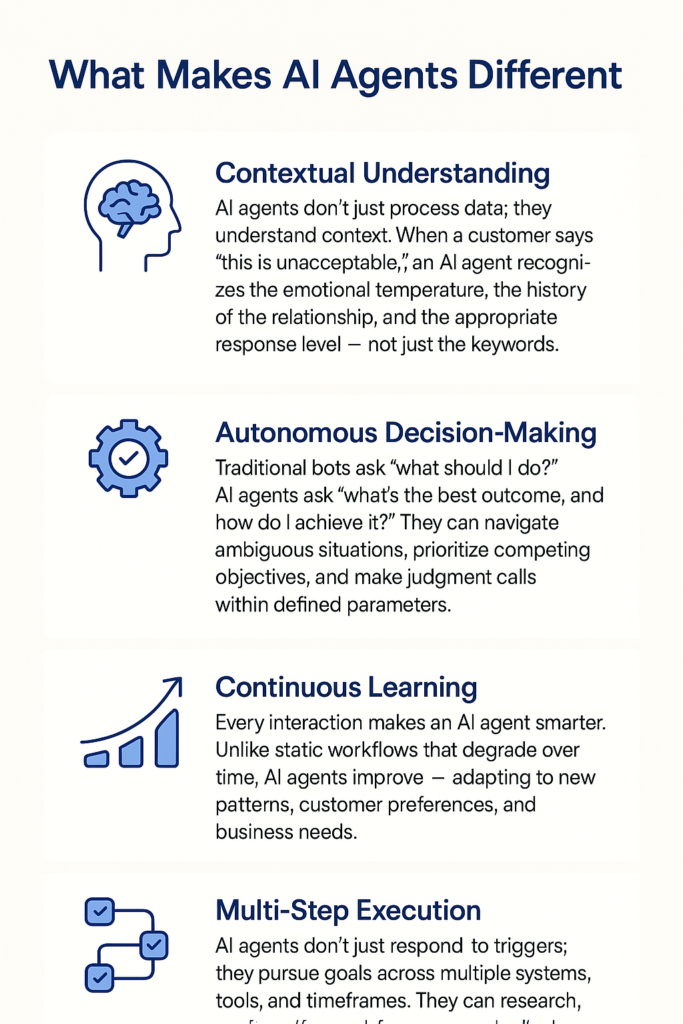
Contextual Understanding: AI agents don’t just process data; they understand context. When a customer says “this is unacceptable,” an AI agent recognizes the emotional temperature, the history of the relationship, and the appropriate response level — not just the keywords.
Autonomous Decision-Making: Traditional bots ask “what should I do?” AI agents ask “what’s the best outcome, and how do I achieve it?” They can navigate ambiguous situations, prioritize competing objectives, and make judgment calls within defined parameters.
Continuous Learning: Every interaction makes an AI agent smarter. Unlike static workflows that degrade over time, AI agents improve — adapting to new patterns, customer preferences, and business needs.
Multi-Step Execution: AI agents don’t just respond to triggers; they pursue goals across multiple systems, tools, and timeframes. They can research, draft, verify, send, follow up, and adjust — all without human intervention.
Imagine the Transformation
Close your eyes for a moment and picture your morning — but different.
You wake up to a notification: “Overnight Activity Summary.” Your AI agent handled 47 customer inquiries. Three were escalated with full context summaries, prioritized by urgency and revenue impact. Two new sales opportunities were identified and initial outreach was drafted — waiting for your approval, not your labor.
The invoice error? Caught and corrected before it sent. The social campaign? Rescheduled automatically when the platform issue was detected, with an alternative time slot chosen based on your audience engagement data.
Your best employee? She’s now spending her time on strategic analysis because the data entry handles itself.
This isn’t science fiction. This is what AI agents enable today.
How AI Agents Improve Business Automation: Real Applications
The theoretical is compelling. But let’s get concrete. Here’s how AI agents are transforming specific business functions:
Customer Service & Support
Traditional Automation: Chatbot responds with pre-written answers. Customer gets frustrated. Escalation required.
AI Agent Approach: Agent understands the customer’s actual problem (even when poorly explained), accesses order history and account data, determines the optimal resolution, executes the solution, and follows up to confirm satisfaction — all while maintaining a human-like conversational flow.
Business Impact: Companies implementing AI agents for customer service report up to 40% reduction in resolution time and significant improvements in customer satisfaction scores.
Sales & Lead Management
Traditional Automation: Lead captured → Added to sequence → Generic emails sent on schedule.
AI Agent Approach: Agent researches the lead (company, role, recent news), personalizes outreach based on specific pain points, adjusts timing based on engagement signals, qualifies interest through intelligent conversation, and schedules meetings at optimal conversion windows.
Business Impact: AI-powered sales automation can boost qualified lead conversion by 30% or more, according to recent industry analyses by Gartner.
Operations & Process Management
Traditional Automation: Workflows trigger based on conditions. Exceptions require manual intervention.
AI Agent Approach: Agent monitors operations continuously, identifies bottlenecks before they cause delays, reallocates resources dynamically, and makes optimization decisions based on real-time data and historical patterns.
Business Impact: Operational efficiency gains of 25–50% are documented across early adopters, with the most significant improvements in exception handling and adaptive resource allocation.
Content & Marketing
Traditional Automation: Schedule posts. Track metrics. Generate reports.
AI Agent Approach: Agent analyzes audience engagement patterns, generates content variations, tests performance across segments, optimizes distribution timing, and continuously refines strategy based on what’s actually working — not what worked six months ago.
Business Impact: Marketing teams using AI agents report 2–3x improvement in content performance metrics and dramatic reductions in time spent on routine optimization tasks.
Implementing AI Agents: The Strategic Path Forward
Understanding the potential is step one. Capturing it requires a strategic approach.
Start With High-Impact, Low-Risk Processes
The most successful AI agent implementations begin with processes that share these characteristics:
- High volume: Tasks that happen frequently enough to generate learning data
- Clear success criteria: Outcomes that can be measured and optimized
- Defined boundaries: Parameters within which autonomous decisions are appropriate
- Reversible decisions: Initial mistakes can be corrected without catastrophic consequences
Customer service inquiries, lead qualification, and routine data processing fit these criteria perfectly. Start there, prove value, then expand.
Build the Right Foundation
AI agents are only as effective as the data and systems they can access. Before deployment, ensure:
- Data Quality: Clean, structured, accessible data across your key systems
- System Integration: APIs and connections that allow agents to access and act across platforms
- Clear Governance: Defined parameters for autonomous action and escalation protocols
- Human Oversight: Monitoring systems that ensure agents operate within intended boundaries
Measure What Matters
The true value of AI agents isn’t just time saved — it’s outcomes improved. Track:
- Resolution quality: Are problems being solved better, not just faster?
- Customer satisfaction: How do recipients rate AI-handled interactions?
- Employee impact: Is human talent being freed for higher-value work?
- Business outcomes: Revenue, retention, and growth metrics tied to automated processes
- Learning velocity: How quickly are agents improving their performance?
The Hidden Cost of Waiting
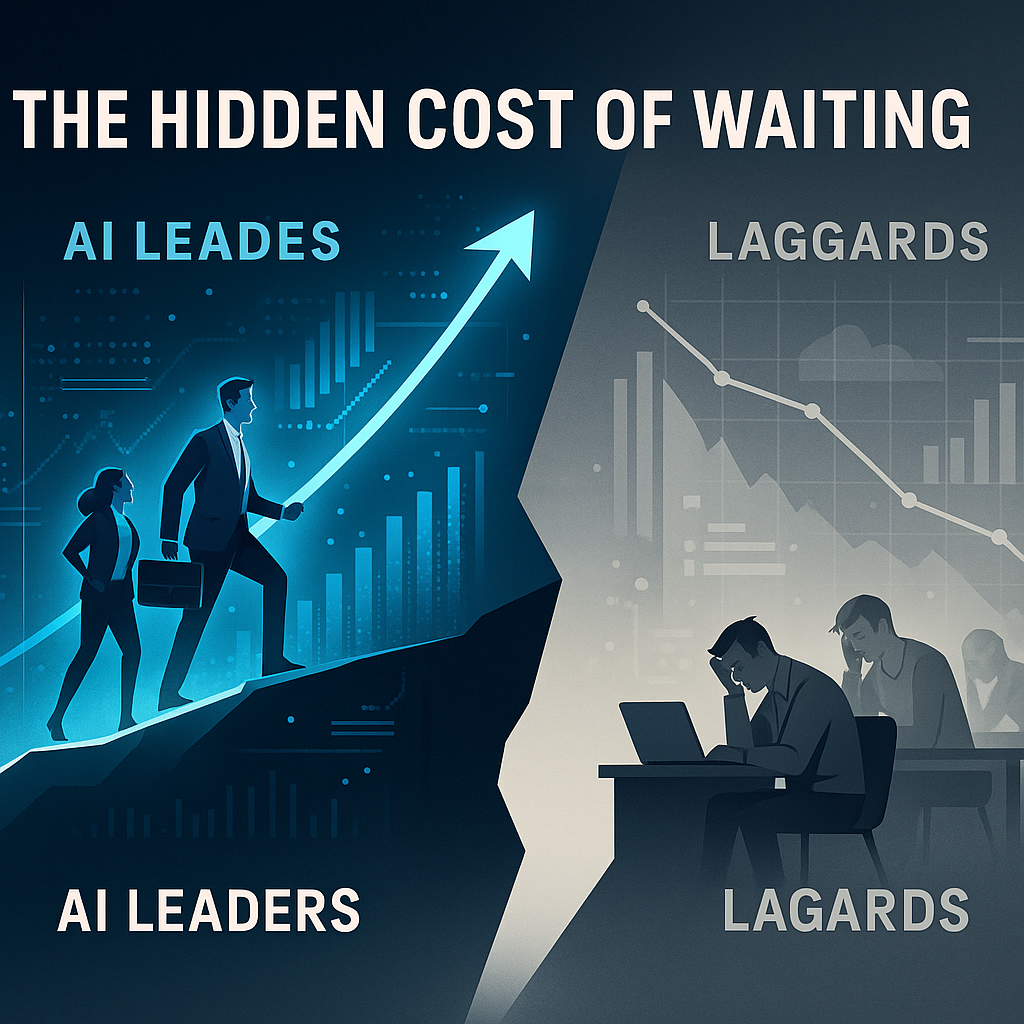
Here’s the uncomfortable truth: AI agent adoption is accelerating rapidly. According to Deloitte’s State of AI report, organizations implementing AI at scale are seeing measurably higher returns, and the gap between leaders and laggards is widening.
Every month you delay, competitors who move now are:
- Building more sophisticated customer relationships
- Operating at higher efficiency margins
- Compounding their AI’s learning advantage
- Freeing their best people for strategic innovation
This isn’t fear-mongering. It’s math. AI agents that start learning today will be dramatically more effective in twelve months than agents deployed twelve months from now.
The Future You’re Building
Let’s return to that morning scene one more time.
Imagine it’s six months from now. You’ve implemented AI agents across your core operations. What does your day look like?
You wake up when your body decides — not when crises demand. Your first action isn’t firefighting; it’s reviewing strategic recommendations your agents have prepared overnight. Customer satisfaction is up. Employee turnover is down. And that best employee? She’s leading a new initiative that’s opening an entirely new revenue stream — work that was impossible when she was buried in busywork.
You’re not managing tasks anymore. You’re architecting growth.
This is the shift from business operator to business architect. It’s what AI agents make possible.
Your Next Step
The question isn’t whether AI agents will transform business automation. That transformation is already underway. The question is whether you’ll be leading that transformation in your market — or scrambling to catch up.
Here’s your actionable path forward:
- Audit Your Operations: Identify the three processes that consume the most human time for routine decisions. These are your high-impact starting points.
- Define Success Metrics: What would “better” look like for each process? Faster resolution? Higher conversion? Fewer errors? Get specific.
- Explore AI Agent Platforms: Research solutions designed for your specific industry and use cases. The landscape is evolving rapidly, and the right partner matters.
- Start Small, Learn Fast: Deploy your first AI agent on a contained process. Measure results. Iterate. Scale what works.
The businesses that thrive in the next decade won’t be the ones with the biggest teams. They’ll be the ones with the smartest systems — systems that think, adapt, and execute without requiring human attention for every decision.
AI agents make that possible. The only question remaining is: how soon do you want to start?
Further Reading & Resources
To deepen your understanding of AI agents and business automation, explore these authoritative sources:
- McKinsey & Company: The State of AI in Business — Comprehensive analysis of AI adoption trends and ROI
- Gartner: AI and Automation Market Analysis — Industry forecasts and implementation frameworks
- MIT Technology Review: AI Agents Explained — Technical deep-dives into agent architectures
- Deloitte: AI in the Enterprise — Enterprise deployment strategies and case studies