
The 7 Best AI Agents for Customer Service in 2025: Your Escape from Support Chaos
How intelligent automation is transforming overwhelmed support teams into strategic powerhouses
Picture this: It’s Monday morning. You haven’t even finished your coffee when the notification count on your support dashboard climbs past 200 unresolved tickets. Your senior agent just submitted her resignation — the third this quarter. And somewhere in that queue, a customer who’s been waiting for more than a hour is about to post a scathing review that will live on the internet forever.
You feel the familiar weight settle into your shoulders. The weight of knowing that every ticket represents a real person with a real problem, and there simply aren’t enough hours — or humans — to solve them all.
If this scenario hits uncomfortably close to home, you’re not alone. And more importantly, you’re not stuck.
The best AI agents for customer service aren’t the robotic chatbots that frustrated your customers five years ago. They’re sophisticated systems that actually understand context, resolve complex issues, and free your human team to do what humans do best — build genuine relationships.
This guide cuts through the hype to show you exactly which AI customer service agents deliver real results in 2025, and how to choose the right one for your specific situation.
The Customer Service Crisis Nobody’s Talking About
Before we dive into solutions, let’s acknowledge the scope of the problem. Because if you’re feeling overwhelmed, there’s a reason — and it’s not your fault.
The customer service industry is hemorrhaging talent at an alarming rate. Annual turnover in contact centers hovers between 30-45%, with some organizations experiencing rates exceeding 200%. Think about that: in the worst cases, an entire support team might turn over twice in a single year.
The human cost is staggering. Over 63% of contact center agents report experiencing burnout, driven by relentless call volumes, frustrated customers, and the emotional exhaustion of absorbing complaints day after day. Each departing agent costs between $10,000 and $21,000 to replace — and that doesn’t account for the institutional knowledge that walks out the door with them.

Meanwhile, customer expectations keep climbing. People want instant responses. They want problems solved on the first contact. And they’ll abandon brands that fail to deliver — with 96% willing to leave after a single bad service experience.
The math simply doesn’t work anymore. You can’t hire your way out of this problem. The old model is broken.
Why AI Agents Aren’t Your Grandmother’s Chatbots
If you’re skeptical about AI in customer service, you have every right to be. Early chatbots were frustrating — rigid scripts that couldn’t handle variation, endless loops that trapped customers, and the maddening experience of shouting “REPRESENTATIVE” into a phone.
Modern AI agents are fundamentally different. They’re built on large language models (LLMs) that actually understand the meaning behind words, not just keywords. They can interpret context, recognize intent, adjust tone, and navigate complex multi-step problems.
The shift is dramatic. First response times that once stretched to six hours can drop to under four minutes with AI-powered support. Resolution times that took 32 hours can shrink to 32 minutes. And companies are seeing returns of $3.50 for every dollar invested, with leading organizations achieving up to 8x ROI.
But here’s what matters most: this isn’t about replacing your human team. It’s about liberating them.
Imagine your best agents spending their time on conversations that actually require human creativity, empathy, and judgment — while AI handles the password resets, order status checks, and routine inquiries that consume 70-80% of typical support volume.
Companies using AI in support report a 43% drop in employee turnover among frontline representatives. When agents do meaningful work instead of repetitive drudgery, they stay.
What Separates the Best AI Agents from the Rest
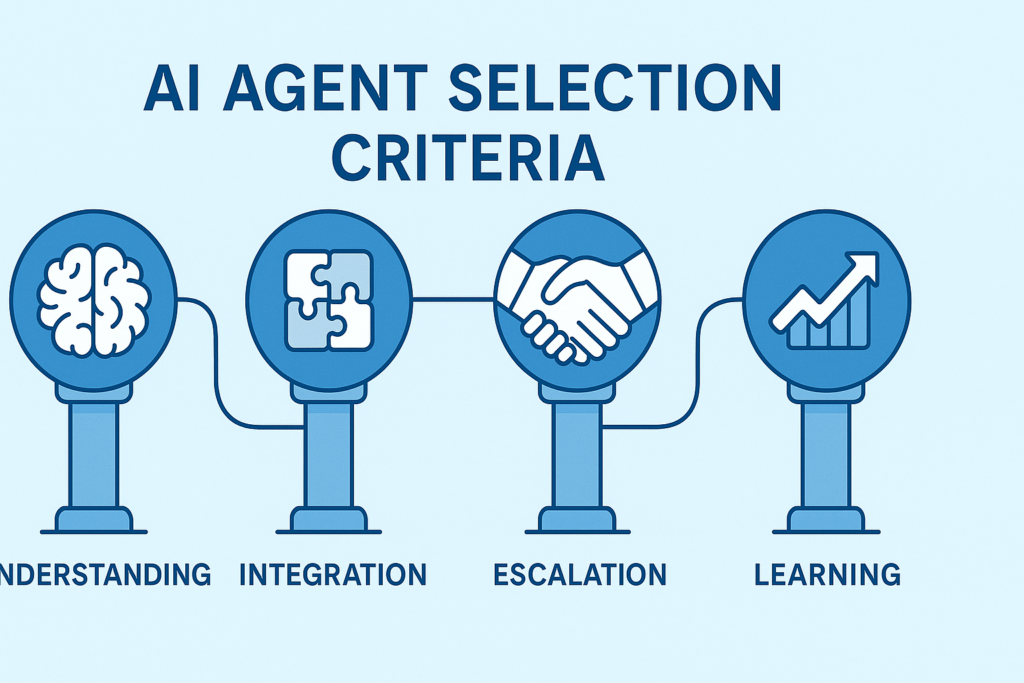
Not all AI customer service agents are created equal. Before we review specific platforms, understand what distinguishes truly effective solutions:
Natural Language Understanding Depth
The best agents don’t just match keywords — they comprehend nuance, handle typos gracefully, and understand when a customer says “this thing won’t work” that they need troubleshooting, not a product catalog.
Integration Capabilities
An AI agent is only as useful as the systems it connects to. Look for platforms that integrate with your CRM, help desk, knowledge base, and communication channels without requiring a team of developers.
Escalation Intelligence
The mark of a sophisticated AI agent is knowing when NOT to handle something. Smooth handoffs to human agents — with full context preserved — are essential for maintaining customer trust.
Learning Capability
Static systems become obsolete. The best AI agents improve over time, learning from resolved interactions and adapting to your specific customer base and product nuances.
The 7 Best AI Agents for Customer Service in 2025
After extensive analysis of current market offerings, performance data, and real-world implementations, these seven platforms stand out for their ability to transform customer service operations:
1. Intercom Fin — Best for Complex Query Resolution
Intercom’s Fin represents the cutting edge of AI customer service. Built on a proprietary AI engine specifically designed for support interactions, Fin doesn’t just respond — it resolves.
Key Strengths: Fin uses a continuous improvement loop called the ‘Fin Flywheel’ — training on your specific procedures, testing performance before launch, deploying across channels, then analyzing results to improve accuracy. This means the system gets smarter with every interaction.
Channel Coverage: Voice, email, chat, and social media — all from one platform with consistent quality.
Ideal For: Companies handling complex product inquiries where accuracy matters more than speed alone. SaaS companies, technical products, and businesses with extensive knowledge bases see the strongest results.
2. Zendesk AI — Best for Enterprise-Scale Operations
For organizations already invested in the Zendesk ecosystem, their AI agents deliver human-first, empathetic service with the advantage of being pre-trained on over 18 billion real service interactions.
Key Strengths: Zendesk’s AI uses retrieval-augmented generation (RAG) to synthesize responses from multiple knowledge sources, ensuring accurate and contextual answers. The auto-triage capability routes tickets based on intent and sentiment before humans ever see them.
Hybrid Flows: Seamless transitions between AI and human agents with complete conversation context preserved — critical for maintaining customer trust during complex escalations.
Ideal For: Large enterprises focused on both customer and employee satisfaction, especially those already using Zendesk products who want deep native integration.
3. Freshdesk Freddy AI — Best for Growing Teams
Freshdesk offers both autonomous support agents and AI copilots, making it versatile for teams at different stages of AI adoption.
Key Strengths: The Freddy AI Agent deploys without coding, learning directly from your documents and knowledge base. Meanwhile, the AI copilot assists human agents with real-time suggestions, ticket summaries, and relevant resolution recommendations.
Omnichannel Unification: Email, chat, phone, and social conversations flow into one platform, giving agents complete context regardless of where customers reach out.
Pricing: Tiered from free basic plans through enterprise at $95/agent/month, making it accessible for growing companies.
Ideal For: Mid-market companies wanting to start with AI assistance and gradually expand to autonomous resolution as confidence grows.
4. Tidio Lyro — Best Balance of Affordability and Security
For small to medium businesses watching every dollar while still needing enterprise-grade capabilities, Tidio Lyro delivers exceptional value.
Key Strengths: What sets Lyro apart is its security-first approach. Rather than exposing personal data in chat conversations, it directs customers to secure account areas — a practice that should be the gold standard but often isn’t. Cost per conversation starts at just $0.50.
E-commerce Integration: Deep connections with e-commerce platforms keep customer data and conversation histories synchronized, enabling contextual responses.
Ideal For: E-commerce businesses and SMBs needing professional AI support without enterprise budgets, especially those handling sensitive customer information.
5. Microsoft Azure AI Bot Service — Best for Custom Development
For organizations with development resources wanting maximum customization, Azure’s AI platform offers unparalleled flexibility.
Key Strengths: Build anything from basic FAQ bots to advanced multi-modal, retrieval-augmented assistants. Access the Bot Framework SDK alongside orchestration workflows and serverless functions. Integration with Azure’s full suite of Cognitive Services — Speech, Vision, Language — enables capabilities beyond text.
Pricing Model: Pay-as-you-go based on Bot Service traffic and API calls rather than per-user licenses, scaling with actual usage.
Ideal For: Organizations with technical teams wanting to build highly customized AI experiences or integrate AI into complex existing systems.

6. Salesforce Einstein Copilot — Best for CRM Integration
For organizations built around Salesforce, Einstein Copilot provides AI capabilities natively embedded across all Salesforce applications.
Key Strengths: The platform can query historical customer transcripts to determine sentiment and build follow-up communications based on previous interactions. This deep CRM integration means AI responses reflect the complete customer relationship, not just the current conversation.
Dynamic Automation: Beyond answering queries, Einstein Copilot can develop content and automate actions across the Salesforce ecosystem.
Ideal For: Salesforce-centric organizations wanting AI that leverages their existing customer data investment for personalized, context-aware service.
7. Cognigy — Best for Global Enterprise Deployment
Designed exclusively for large, global enterprises with high-volume contact centers, Cognigy provides the foundational technology for building, managing, and deploying highly customized AI agents.
Key Strengths: LLM orchestration allows businesses to use and switch between different language models from vendors like OpenAI and Google, finding the best model for each specific task. This flexibility future-proofs your investment as AI technology evolves.
Deployment Options: Standard SaaS, private cloud, or fully on-premises within your own data center — critical for regulated industries with strict data sovereignty requirements.
Client Profile: Major brands like Toyota, Lufthansa, and Nestle trust Cognigy for their global customer service operations.
Ideal For: Fortune 500 companies and regulated industries requiring maximum control, customization, and deployment flexibility.
Quick Comparison: Finding Your Match
| Platform | Best For | Standout Feature | Company Size |
| Intercom Fin | Complex queries | Continuous learning | Mid-market to Enterprise |
| Zendesk AI | Enterprise scale | 18B+ training interactions | Enterprise |
| Freshdesk Freddy | Growing teams | Agent copilot + autonomous | SMB to Mid-market |
| Tidio Lyro | Budget-conscious | Security-first approach | SMB |
| Azure AI Bot | Custom development | Full Azure integration | Any (with dev resources) |
| Salesforce Einstein | CRM integration | Native Salesforce data access | Mid-market to Enterprise |
| Cognigy | Global enterprise | LLM orchestration | Large Enterprise |
The Numbers That Matter: Understanding AI ROI
Let’s talk about what these tools actually deliver in measurable results. The data from real implementations paints a compelling picture:
Cost per interaction drops dramatically — from an average of $4.32 for human-handled service to $0.18 with AI, a reduction of nearly 96%. For high-volume operations, this translates to millions in annual savings.
Response speed transforms the customer experience. First response times can drop from six hours to under four minutes. Resolution times compress from 32 hours to 32 minutes in some implementations.
Agent capacity multiplies when AI handles routine work. AI-augmented agents can handle three times the ticket volume of traditional setups, not by working harder but by focusing human effort where it matters.
The ROI timeline is faster than many expect. Companies report earning $1.41 per dollar invested in the first year, growing to 124% ROI by year three as systems learn and optimize.
But perhaps the most significant number: a 43% reduction in agent turnover. When you remove the soul-crushing repetition from your team’s daily work, they stay. And experienced agents who stay deliver better service, creating a virtuous cycle that compounds over time.
Your Next Step: From Chaos to Control
Remember that Monday morning scenario? The overflowing inbox, the resignation letter, the customer about to explode online?
Now imagine a different version. You walk into your office, and the dashboard shows AI resolved 73% of overnight tickets while you slept. Your senior agent is preparing for a strategic planning session instead of drowning in password resets. The few remaining escalations are genuinely interesting problems that your team has time and energy to solve thoughtfully.
That’s not fantasy. It’s what the best AI agents for customer service make possible — today, with technology that’s already proven at scale.
Here Is How to Move Forward
Here’s how to move forward based on your situation:
- If you’re a growing SMB watching costs carefully: Start with Tidio Lyro or Freshdesk’s free tier. Test on a single channel. Measure the impact on response times and agent workload before expanding.
- If you’re mid-market with complex products: Evaluate Intercom Fin or Freshdesk’s full Freddy suite. The continuous learning capabilities pay dividends as the system masters your specific use cases.
- If you’re enterprise-scale in a regulated industry: Cognigy or Zendesk AI provide the control, compliance, and deployment flexibility you need. Don’t compromise on security for speed to market.
- If you’re already committed to Salesforce: Einstein Copilot leverages your existing data investment in ways third-party tools simply can’t match.
The customer service model that’s burning out your team and frustrating your customers is fixable. Not with another hire who’ll leave in 13 months. Not with more scripts that customers see through instantly. With intelligent technology that handles the grind so your people can do what humans do best.
The tools exist. The ROI is proven. The question isn’t whether AI customer service agents work — it’s how much longer you’ll wait while competitors pull ahead.
Your Monday mornings don’t have to feel like this. What happens next is your call.
Further Reading & Resources
ROI benchmarks and implementation frameworks: Freshworks’ CX 2025 Benchmark Report
Comprehensive AI customer service statistics and trends: Zendesk’s 2025 AI Customer Service Report
In-depth platform comparisons and methodology: AIMultiple Research on AI Agents