
AI-Powered Virtual Assistants for Enterprises: The Invisible Workforce That Makes Every Employee Unstoppable
Picture your Monday morning.
You settle into your desk chair, coffee still warm in your hand. You open your laptop. And there it is: 147 unread emails. Three urgent Slack threads you missed over the weekend. A support ticket that’s been escalated twice. The VPN isn’t connecting properly. You need to request access to a new tool, but you can’t remember which portal handles that. Someone’s asking about the PTO policy — again — and you’re not even in HR.
By 9:30 AM, you haven’t started the work you’re actually paid to do. You’re drowning in operational friction — the invisible tax that drains productivity from every employee, every day, in every enterprise.
Research confirms what you already feel: employees lose up to 62% of their workday to mundane administrative tasks. They toggle between dozens of applications, wait in support queues, and hunt through documentation for answers that should be instant. The cognitive load is crushing. The frustration is real. And the cost to your organization is staggering.
This is the problem that AI-powered virtual assistants for enterprises were designed to solve. Not with incremental improvements. Not with another chatbot that can’t actually do anything. But with a fundamentally different approach — intelligent assistants that don’t just answer questions, but take autonomous action to eliminate friction at its source.
The Broken Promise of Enterprise Automation
If you’re skeptical, you’ve earned the right to be.
Enterprises have been promised “digital transformation” and “intelligent automation” for years. Yet most organizations still spend 60-80% of their IT budget just maintaining existing operations, leaving barely 20-30% for actual innovation. The chatbots deployed in the 2010s became jokes — scripted, brittle systems that frustrated users more than they helped. The automation tools required so much configuration and maintenance that they often created more work than they saved.
The core problem? Traditional automation relies on rigid, if-this-then-that logic. It can execute predefined tasks, but it can’t adapt. It can’t understand context. It can’t reason through novel situations. And it certainly can’t handle the messy, unpredictable reality of how employees actually work.
According to a comprehensive Harvard Business Review analysis, only 26% of companies have functioning AI products in production, and just 4% have achieved meaningful ROI. The gap between AI’s promise and its delivery has bred justified cynicism in boardrooms and IT departments alike.

But something has changed. And it’s changing everything.
The Rise of Agentic AI: From Answering to Acting
The latest generation of AI-powered virtual assistants for enterprises operates on a fundamentally different paradigm: agentic AI.
Unlike traditional chatbots that follow scripts, agentic AI assistants can reason, adapt, and take autonomous action across systems. They don’t just tell you what to do — they do it for you. They don’t just surface information — they execute workflows, update systems, resolve issues, and orchestrate complex multi-step processes without constant human supervision.
Think of it as the difference between a GPS that gives you directions and a self-driving car that takes you to your destination. Both use intelligence, but one requires you to do all the work while the other handles it autonomously.
The numbers tell the story of a market that recognizes this shift. The intelligent virtual assistant market is valued at $19.60 billion in 2025 and is projected to explode to $80.72 billion by 2030 — a 32.72% compound annual growth rate. Enterprise adoption is accelerating: according to Google Cloud’s AI Trends Report, 82% of executives at large enterprises plan to integrate AI agents within the next three years, with 71% believing these agents will significantly increase workflow automation and improve customer service.
This isn’t hype. It’s infrastructure investment at scale.
What Enterprise AI Assistants Actually Do: The Invisible Workforce in Action
Imagine this scene: A new hire named Alex starts their first day. In the old world, their excitement would fade within hours — laptop not configured, systems inaccessible, IT tickets sitting in queue, unclear who to ask for help. Days of friction before productive work begins.
Now imagine Alex typing a simple message to the company’s AI assistant: “I need access to Salesforce and the Q4 marketing files.”
Within seconds, the assistant understands the request, verifies Alex’s role and permissions, provisions the Salesforce account, grants access to the appropriate SharePoint folders, and confirms completion — all without a single support ticket, without IT involvement, without Alex navigating five different portals.
This is the invisible workforce in action.
Modern AI-powered virtual assistants for enterprises operate as an intelligent layer between employees and the complex web of enterprise systems. They integrate with identity management, HRIS platforms like Workday, IT service management tools, knowledge bases, and productivity suites — creating a unified experience where employees can accomplish anything through natural conversation.
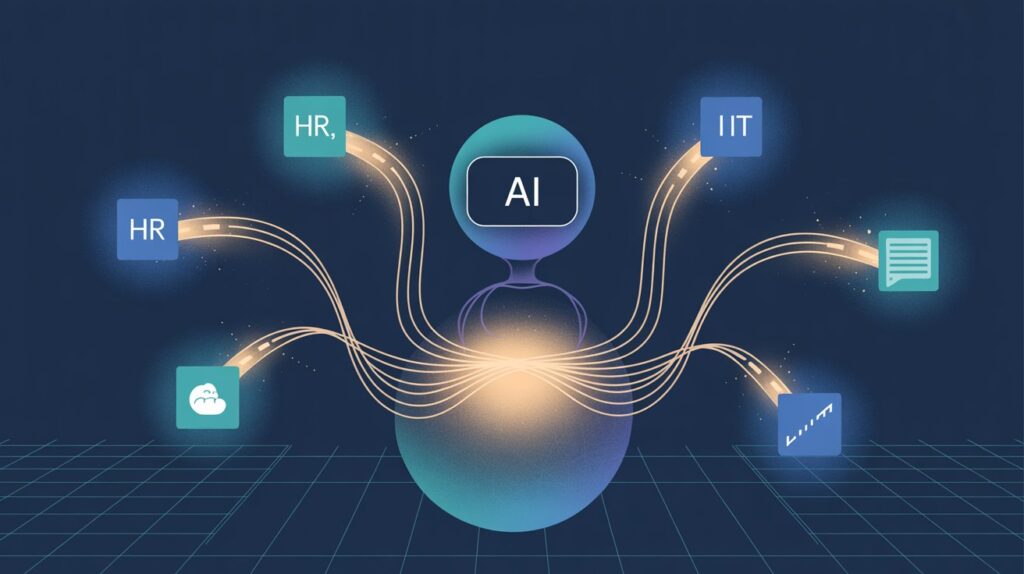
The scope of what these assistants handle is remarkable:
- IT Support: Password resets, software access requests, troubleshooting common issues, equipment provisioning — studies show AI assistants can handle up to 70% of routine inquiries without human intervention, reducing support costs by up to 40%.
- HR Operations: PTO requests, benefits questions, onboarding workflows, policy clarifications — HR teams typically spend 57% of their time on repetitive requests that AI can handle instantly.
- Finance Processes: Expense inquiries, invoice routing, budget approvals, vendor status checks — automating these processes removes friction from cross-departmental workflows.
- Knowledge Management: Finding documents, surfacing relevant policies, answering procedural questions — employees get instant, accurate answers instead of hunting through outdated intranets.
- Cross-functional Orchestration: Complex requests that span multiple departments and systems, handled seamlessly through a single conversational interface.
The Evidence: Real Results from Real Enterprises
The business case for AI-powered virtual assistants has moved from theoretical to proven. Here’s what enterprises are actually experiencing:
IBM has reported that AI and automation have helped unlock $4.5 billion in productivity gains across the company since 2023. Their AI-integrated customer support resolves 70% of inquiries through digital assistants, while time-to-resolution for complex issues improved by 26%. Customer satisfaction increased by 25 points.
At Siemens, an AI assistant now supports 250,000+ employees across 190+ countries, handling thousands of IT support requests monthly with multilingual capabilities. The system doesn’t just deflect tickets — it proactively surfaces help before employees even ask, fundamentally transforming the support experience.
A Stanford, MIT, and NBER study found that access to AI assistance increased worker productivity by 15% on average, as measured by issues resolved per hour. Best Buy is resolving customer issues up to 90 seconds faster using their AI-powered assistants.
According to Deloitte’s State of Generative AI report, almost 74% of organizations say their most advanced AI initiatives are meeting or exceeding ROI expectations. IDC’s January 2025 study found that organizations averaged a 3.7x return per dollar invested in generative AI, with top performers achieving 10.3x returns.
These aren’t pilot programs. These are enterprise-scale deployments delivering measurable, material impact on the bottom line. For additional context on enterprise AI transformation, see McKinsey’s State of AI research and Google Cloud’s real-world AI use cases.
The 24/7 Advantage: Why “Always On” Changes Everything
Picture this: It’s 2 AM in Singapore. A sales executive needs access to updated pricing sheets before a critical morning meeting. Under the old model, they’d wait until the London office opened — losing precious preparation time and potentially the deal.
With an AI-powered enterprise assistant, they simply ask. The system verifies their permissions, locates the current pricing documentation, and delivers it instantly. No timezone barriers. No support tickets languishing in queue. No frustrated employee. No lost opportunity.
This “always on” capability isn’t just convenience — it’s a fundamental competitive advantage for global enterprises. When employees can get instant, accurate support regardless of location or hour, you eliminate an entire category of productivity friction.
Over 60% of consumers in developed markets now engage with virtual assistants daily for tasks ranging from simple information retrieval to complex operations. This behavioral shift is migrating into the enterprise, where employees increasingly expect consumer-grade instant support experiences in their professional tools.

From Pilot to Production: How Enterprises Make It Work
The path from AI curiosity to AI impact follows a pattern among successful enterprises:
Start Focused, Think Big: Begin with a high-impact use case — typically IT support or HR operations — where friction is obvious and measurable. But architect the solution with enterprise-wide expansion in mind.
Integrate Deeply: The power of AI assistants comes from their connections. Systems like HRIS, identity management, service desks, and knowledge bases must feed into the assistant for it to take meaningful action. This isn’t about adding another tool — it’s about creating an intelligent layer across existing infrastructure.
Prioritize Change Management: Technology deployment is only half the challenge. Internal champions, clear communication, and demonstrable quick wins drive the adoption that transforms pilots into production value.
Iterate Continuously: The best AI assistant deployments treat the system as a living product. Regular updates, new use cases, and continuous refinement keep the assistant relevant and valuable.
Measure What Matters: Track ticket deflection, time-to-resolution, employee satisfaction, and adoption rates. These metrics demonstrate ROI and guide expansion decisions. For frameworks on measuring AI automation value, explore resources from IBM’s enterprise AI transformation insights and Deloitte’s State of Generative AI research.
The Future State: What the AI-Powered Enterprise Looks Like
Close your eyes for a moment. Imagine walking into work six months from now — after your organization has fully deployed an intelligent AI assistant.
Your new hires onboard smoothly, with systems provisioned and training scheduled before they arrive. Your IT team focuses on strategic projects instead of password resets. Your HR professionals spend their energy on culture and talent development instead of answering the same benefits questions for the hundredth time. Your employees feel the satisfaction of actually completing meaningful work instead of fighting administrative friction.
The organization hums with efficiency. Support satisfaction scores climb. Employee engagement improves. The invisible drag that was costing you millions in lost productivity has transformed into flow.
This isn’t fantasy. It’s the documented experience of enterprises that have made the transition — from IBM’s $4.5 billion in productivity gains to Siemens’ global support transformation to countless organizations quietly revolutionizing how work gets done.

Your Move: From Friction to Flow
The question facing enterprise leaders isn’t whether AI-powered virtual assistants will transform how organizations operate — that transformation is already underway, documented in the numbers and proven by market adoption.
The question is whether you’ll be among the leaders who capture the 3.7x average returns and competitive advantage, or among those who watch from the sidelines as your competitors make every employee faster, smarter, and more effective.
The invisible workforce is ready. The technology has matured. The ROI is proven. The enterprises that move now will compound their advantages while others are still scheduling evaluation meetings.
Start by auditing your friction points. Where do employees waste the most time on administrative tasks? Where do support tickets pile up? Where does onboarding drag? These are your highest-value targets.
Then imagine the transformation. Not incremental improvement — but friction becoming flow. Not another tool to manage — but an intelligent layer that makes every other tool work better. Not chatbots that frustrate — but AI assistants that actually get things done.
The future of enterprise productivity isn’t about working harder. It’s about working with an invisible workforce that handles the busywork so your people can do what they were hired to do: create value, solve problems, and drive your organization forward.